


Page 39 - Wallingford Magazine Issue 59 Spring 2026
P. 39
of two or three justices of the quorum.”   sometimes  dramatic  glimpses  of  the  icant  obstacle  when  probate  matters
       Like the county courts, these first pro-  life  [and]  mores”    during  pre-Revolu-  demanded  repeated appearances and
       bate courts were seated in each of the  tionary period, not unlike today.  Given  personal participation. In that setting,
       colony’s  four  original  counties.    Thus,  the sensitive nature of these matters—  distance was not merely inconvenient;
       Wallingford  residents  still  needed  to  death,  inheritance,  family  structure,  it directly affected access to justice in
       travel to New Haven to have their pro-  and  personal  incapacity—it  is  not  matters requiring ongoing engagement
       bate matters heard and adjudicated.     surprising  that  Wallingford  residents  with the court.
                                            sought a forum that was closer, more
       By 1719, the General Assembly had be-  familiar, and, likely, more responsive to
       gun to establish probate districts small-  local conditions.  A locally situated pro-
       er than an entire county.  This marked  bate  court  better  aligned  judicial  au-
       the beginning of a long-term shift to-  thority with community trust, ensuring
       ward increasingly localized probate ad-  that the administration of estates and
       ministration—a trend that persisted for  guardianships occurred within the so-
       more than two and a half centuries,   in-  cial and moral framework of the town
       cluding the creation of the Wallingford  itself.
       Probate District 250 years ago.
                                            Second,  the  town’s  petition  also  re-
                                            flects the maturation of Wallingford it-
                                            self.  According to Wallingford historian
                                            Bob  Beaumont,  by  1775,  Wallingford
                                            was more than just a stable, organized
                                            community; at more than one hundred
                                            years old it was already functioning as a
                                            mature civic and political body.  Based
                                            on  the  census  of  January  1,  1774,  it
                                            was the 9th  largest town  in the colo-
                                            ny with 4,915 residents. That total was
                                            only 116 less than Hartford.  Beaumont
                                            also observed that eighteenth-century
                                            Wallingford encompassed roughly 100
                                            square miles, a territory that included
                                            what are now Meriden, Cheshire, and
                                            part of Prospect.
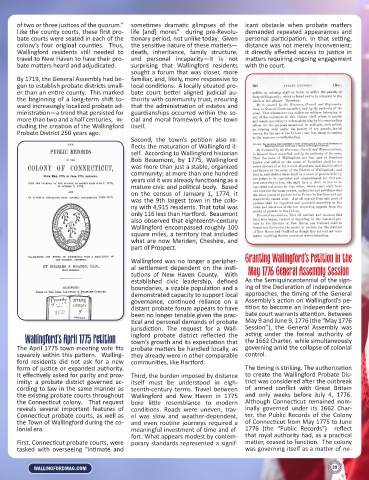
                                            Wallingford was no longer a peripher- Granting Wallingford’s Petition in the

                                            al  settlement  dependent  on  the  insti-  May 1776 General Assembly Session
                                            tutions  of  New  Haven  County.    With
                                            established  civic  leadership,  defined   As the Semiquincentennial of the sign-
                                            boundaries, a sizable population and a   ing of the Declaration of Independence
                                            demonstrated capacity to support local   approaches, the timing of the General
                                            governance,  continued  reliance  on  a   Assembly’s action on Wallingford’s pe-
                                            distant probate forum appears to have   tition to become an independent pro-
                                            been no longer tenable given the prac-  bate court warrants attention. Between
                                            tical and personal demands of probate   May 9 and June 9, 1776 (the “May 1776
                                            jurisdiction.  The  request  for  a  Wall-  Session”),  the  General  Assembly  was
         Wallingford’s April 1775 Petition  ingford  probate  district  reflected  the   acting  under  the  formal  authority  of
                                                                                 the 1662 Charter,  while simultaneously
                                            town’s growth and its expectation that
       The April 1775 town meeting vote fits  probate matters be handled locally, as   governing amid the collapse of colonial
       squarely within this pattern.  Walling-  they already were in other comparable   control.
       ford  residents  did  not  ask  for  a  new  communities, like Hartford.
       form of justice or expanded authority.                                    The timing is striking. The authorization
       It effectively asked for parity and prox-  Third, the burden imposed by distance   to create the Wallingford Probate Dis-
       imity:  a  probate  district  governed  ac-  itself  must  be  understood  in  eigh-  trict was considered after the outbreak
       cording to law in the same manner as  teenth-century  terms.  Travel  between   of  armed  conflict  with  Great  Britain
       the existing probate courts throughout  Wallingford  and  New  Haven  in  1775   and  only  weeks  before  July  4,  1776.
       the Connecticut colony.   That request  bore  little  resemblance  to  modern   Although  Connecticut  remained  nom-
       reveals  several  important  features  of  conditions.  Roads  were  uneven,  trav-  inally  governed  under  its  1662  Char-
       Connecticut probate courts, as well as  el  was  slow  and  weather-dependent,   ter,  the  Public  Records  of  the  Colony
       the Town of Wallingford during the co-  and  even  routine  journeys  required  a   of Connecticut from May 1775 to June
       lonial era.                          meaningful investment of time and ef-  1776  (the  “Public  Records”)    reflect
                                            fort. What appears modest by contem-  that royal authority had, as a practical
       First, Connecticut probate courts, were  porary standards represented a signif-  matter, ceased to function.  The colony
       tasked  with  overseeing  “intimate  and                                  was governing itself as a matter of ne-


            WALLINGFORDMAG.COM                                                                                39

