


Page 38 - Wallingford Magazine Issue 59 Spring 2026
P. 38
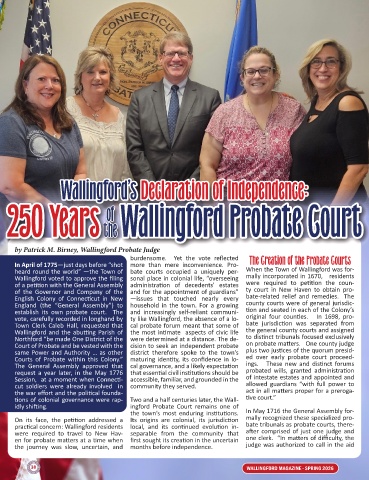
Wallingford’s Declaration of Independence:
                     W   allingf    or   d’ s  Declar      a tion o     f Independenc             e:


                                        Wallingford Probate Court
   250           Y  ear       s      the the W allingf          or     d P      r  oba       te Court
   250 Years
                                    of of


      by Patrick M. Birney, Wallingford Probate Judge
                                            burdensome.    Yet  the  vote  reflected   The Creation of the Probate Courts
      In April of 1775—just days before “shot  more  than  mere  inconvenience.  Pro-
      heard round the world” —the Town of  bate  courts  occupied  a  uniquely  per-  When the Town of Wallingford was for-
      Wallingford voted to approve the filing  sonal place in colonial life, “overseeing   mally incorporated in 1670,   residents
      of a petition with the General Assembly  administration  of  decedents'  estates   were  required  to  petition  the  coun-
      of  the  Governor  and  Company  of  the  and for the appointment of guardians”   ty  court  in  New  Haven  to  obtain  pro-
      English  Colony  of  Connecticut  in  New  —issues  that  touched  nearly  every   bate-related  relief  and  remedies.    The
      England  (the  “General  Assembly”)  to  household  in  the  town.  For  a  growing   county courts were of general jurisdic-
      establish  its  own  probate  court.    The  and  increasingly  self-reliant  communi-  tion and seated in each of the Colony’s
      vote, carefully recorded in longhand by  ty like Wallingford, the absence of a lo-  original  four  counties.      In  1698,  pro-
      Town  Clerk  Caleb  Hall,  requested  that  cal probate forum meant that some of   bate  jurisdiction  was  separated  from
      Wallingford and the abutting Parish of  the most intimate  aspects of civic life   the general county courts and assigned
      Northford “be made One District of the  were determined at a distance. The de-  to distinct tribunals focused exclusively
      Court of Probate and be vested with the  cision to seek an independent probate   on probate matters.   One county judge
      same Power and Authority … as other  district  therefore  spoke  to  the  town’s   plus two justices of the quorum presid-
      Courts  of  Probate  within  this  Colony.”   maturing identity, its confidence in lo-  ed  over  early  probate  court  proceed-

      The  General  Assembly  approved  that  cal governance, and a likely expectation   ings.      These  new  and  distinct  forums
      request  a  year  later,  in  the  May  1776  that essential civil institutions should be   probated  wills,  granted  administration
      Session,  at a moment when Connecti-  accessible, familiar, and grounded in the   of intestate estates and appointed and
      cut  soldiers  were  already  involved    in  community they served.       allowed  guardians  “with  full  power  to
      the war effort and the political founda-                                   act in all matters proper for a preroga-
      tions of colonial governance were rap-  Two and a half centuries later, the Wall-  tive court.”
      idly shifting.                        ingford  Probate  Court  remains  one  of
                                            the  town’s  most  enduring  institutions.   In May 1716 the General Assembly for-
      On  its  face,  the  petition  addressed  a  Its  origins  are  colonial,  its  jurisdiction   mally recognized these specialized pro-
      practical concern: Wallingford residents  local,  and  its  continued  evolution  in-  bate tribunals as probate courts, there-
      were  required  to  travel  to  New  Hav-  separable  from  the  community  that   after comprised  of  just  one  judge  and
      en for probate matters at a time when  first sought its creation in the uncertain   one clerk.  “In matters of difficulty, the
      the  journey  was  slow,  uncertain,  and  months before independence.     judge was authorized to call in the aid


           38                                                                     WALLINGFORD MAGAZINE - SPRING 2026

