


Page 21 - Wallingford Magazine Issue 59 Spring 2026
P. 21
strengthen  the  immune  system  so  it  thought  to  be  therapeutic  for  people
       could fight and “win” over the disease.  with  tuberculosis.    Borrowing  from
                                            the early US sanatoria in Asheville and
       In  the  United  States,  Wallingford,  CT  Saranac  Lake,  Gaylord  Farm  Sanatori-
       was  an  innovator  in  its  adoption  of  um  was  a  self-contained  complex  of
       a  model  of  not-for-profit  sanatorium  buildings  housing  patients  and  staff,
       care  like  that  of  Saranac  Lake,  NY  in  situated in a rural area of Wallingford.
       1885,  and  distinct  from  the  for-profit  There  would  be  home-like  cottages,
       sanatoria  in  Ashville,  NC  in  1875.    As  often  called  “shacks,”  each  consisting
       early  as  November  1901,  and  prior  of  a  central  sitting  room  with  patient
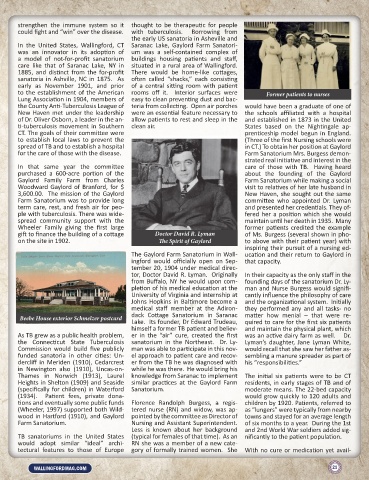
       to the establishment of the American  rooms  off  it.    Interior  surfaces  were   Former patients to nurses
       Lung Association in 1904, members of  easy to clean preventing dust and bac-
       the County Anti-Tuberculosis League of  teria from collecting.  Open air porches  would have been a graduate of one of
       New Haven met under the leadership  were an essential feature necessary to  the  schools  affiliated  with  a  hospital
       of Dr. Oliver Osborn, a leader in the an-  allow patients to rest and sleep in the  and established in 1873 in the United
       ti-tuberculosis movement in Southern  clean air.                          States  based  on  the  Nightingale  ap-
       CT. The goals of their committee were                                     prenticeship model begun in England.
       to  establish  local  laws  to  prevent  the                              (Three of the first Nursing schools were
       spread of TB and to establish a hospital                                  in CT.) To obtain her position at Gaylord
       for the care of those with the disease.                                   Farm Sanatorium Mrs. Burgess demon-
                                                                                 strated real initiative and interest in the
       In  that  same  year  the  committee                                      care  of  those  with  TB.    Having  heard
       purchased  a  600-acre  portion  of  the                                  about  the  founding  of  the  Gaylord
       Gaylord  Family  Farm  from  Charles                                      Farm Sanatorium while making a social
       Woodward Gaylord of Branford, for $                                       visit to relatives of her late husband in
       3,600.00.  The mission of the Gaylord                                     New Haven, she sought out the same
       Farm Sanatorium was to provide long                                       committee  who  appointed  Dr.  Lyman
       term care, rest, and fresh air for peo-                                   and presented her credentials. They of-
       ple with tuberculosis. There was wide-                                    fered her a position which she would
       spread  community  support  with  the                                     maintain until her death in 1935.  Many
       Wheeler  Family  giving  the  first  large                                former  patients  credited  the  example
       gift to finance the building of a cottage    Doctor David R. Lyman        of Ms. Burgess (several shown in pho-
       on the site in 1902.                          The Spirit of Gaylord       to above with their patient year) with
                                                                                 inspiring their pursuit of a nursing ed-
                                            The Gaylord Farm Sanatorium in Wall-  ucation and their return to Gaylord in
                                            ingford  would  officially  open  on  Sep-  that capacity.
                                            tember 20, 1904 under medical direc-
                                            tor, Doctor David R. Lyman.  Originally  In their capacity as the only staff in the
                                            from Buffalo, NY he would upon com-  founding days of the sanatorium Dr. Ly-
                                            pletion of his medical education at the  man and Nurse Burgess would signifi-
                                            University of Virginia and internship at  cantly influence the philosophy of care
                                            Johns Hopkins in Baltimore become a  and the organizational system.  Initially
                                            medical  staff  member  at  the  Adiron-  they  performed  any  and  all  tasks-  no
       Beebe House exterior Schmelzer postcard  dack  Cottage  Sanatorium  in  Saranac  matter  how  menial  –  that  were  re-
                                            Lake.  Its founder, Dr Edward Trudeau,  quired to care for the first six patients
                                            himself a former TB patient and believ-  and maintain the physical plant, which
       As TB grew as a public health problem,  er  in  the  “air”  cure,  created  the  first  was an active dairy farm as well.    Dr.
       the  Connecticut  State  Tuberculosis  sanatorium  in  the  Northeast.    Dr.  Ly-  Lyman’s  daughter,  Jane  Lyman  White,
       Commission  would  build  five  publicly  man was able to participate in this nov-  would recall that she saw her father as-
       funded  sanatoria  in  other  cities:  Un-  el approach to patient care and recov-  sembling a manure spreader as part of
       dercliff in Meriden (1910), Cedarcrest  er from the TB he was diagnosed with  his “responsibilities.”
       in  Newington  also  (1910),  Uncas-on-  while he was there.  He would bring his
       Thames  in  Norwich  (1913),  Laurel  knowledge from Saranac to implement  The  initial  six  patients  were  to  be  CT
       Heights in Shelton (1909) and Seaside  similar  practices  at  the  Gaylord  Farm  residents, in early stages of TB and of
       (specifically for children) in Waterford  Sanatorium.                     moderate means. The 22-bed capacity
       (1934).    Patient  fees,  private  dona-                                 would grow quickly to 120 adults and
       tions and eventually some public funds  Florence  Randolph  Burgess,  a  regis-  children by 1920. Patients, referred to
       (Wheeler, 1997) supported both Wild-  tered nurse (RN) and widow, was ap-  as “lungers” were typically from nearby
       wood in Hartford (1910), and Gaylord  pointed by the committee as Director of  towns and stayed for an average length
       Farm Sanatorium.                     Nursing and Assistant Superintendent.  of six months to a year.  During the 1st
                                            Less  is  known  about  her  background  and 2nd World War soldiers added sig-
       TB  sanatoriums  in  the  United  States  (typical for females of that time).  As an  nificantly to the patient population.
       would  adopt  similar  “ideal”  archi-  RN she was a member of a new cate-
       tectural  features  to  those  of  Europe  gory of formally trained women.  She  With no cure or medication yet avail-


            WALLINGFORDMAG.COM                                                                                21

