


Page 20 - Wallingford Magazine Issue 59 Spring 2026
P. 20
THE GAYLORD FARM                                                    by Celeste Yanni


                SANATORIUM


         Wallingford’s Historic Role in the Control of TB in Connecticut


      Almost  forgotten  now,  Tuberculosis  -  contact.  Those who lived in the same  ed  breathing  as  well  as  long  dresses
      called  the  “great  white  plague,”  was  crowded household seemed to be more  that dragged on the ground.  Children
      a  terrifying  diagnosis  and  the  leading  likely to share the disease.  They also  learned that washing their hands, eat-
      cause of death until the middle of the  were often more likely to live in crowd-  ing nutritious meals and sleeping with
      20th  Century.      This  disease  has  sick-  ed cities, with polluted air, poor hous-  a window open were healthy pursuits.
      ened  and  killed  human  since  ancient  ing, unsanitary working conditions, and
      times.  Signs of it have been found in  inadequate diets.                  Individuals with tuberculosis who could
      Egyptian  mummies.    The  Greeks  and                                     afford a “travel cure” relocated on ex-
      Romans  wrote  about  it.    In  modern                                    panding  railroad  routes  to  seek  drier
      times  important  figures  like  Eleanor                                   and warmer climes.  Towns where the
      Roosevelt  and  Bishop  Tutu  were  af-                                    newly developed railroad stopped, like
      fected.    Individuals  who  suffer  from                                  Denver and Colorado Springs in Colora-
      Tuberculosis,  or  “TB,”  have  symptoms                                   do, Albuquerque in New Mexico, Phoe-
      typically  affecting  the  lungs  causing  a                               nix and Tucson in Arizona, and Los An-
      cough, fever, bloody mucous, pain and-                                     geles in California grew.  Many of those
      in the final stages- dramatic weight loss                                  who  came  seeking  health  remained
      culminating in death.  Thus, one of TB’s                                   when they improved and made signif-
      many names was “consumption.”                                              icant  contributions  to  their  communi-
                                                                                 ties.

                                                                                 In 1882 Robert Koch discovered the tu-
                                                                                 bercule bacillus, the rod-shaped Myco-
                                                                                 bacterium, found in the mucous of the
                                                                                 ill, caused TB.  However, efforts to com-
                                            The diagnosis of TB caused widespread  pletely  arrest  the  disease  would  not
                                            discrimination,  often  with  loss  of  em-  exist until the mid-1940s during WWII.
                                            ployment and housing.  Because of the  In  1946  the  antibiotic,  Streptomycin,
                                            possible threat to others, people who  was made available for use to treat TB
                                            developed TB were reported to health  and other diseases.  As with many new
                                            authorities  and  removed  to  local  and  drugs,  it  was  expensive  and  not  pro-
                                            remote  institutions  for  extended  pe-  duced in enough quantity to treat the
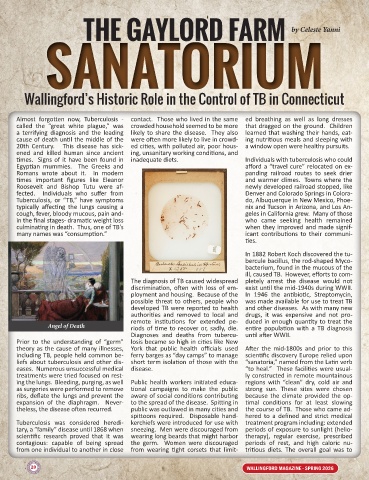
                 Angel of Death             riods of time to recover or, sadly, die.   entire  population  with  a  TB  diagnosis
                                            Diagnoses  and  deaths  from  tubercu-  until after WWII.
      Prior  to  the  understanding  of  “germ”  losis became so high in cities like New
      theory as the cause of many illnesses,  York  that  public  health  officials  used  After  the  mid-1800s  and  prior  to  this
      including TB, people held common be-  ferry barges as “day camps” to manage  scientific discovery Europe relied upon
      liefs about tuberculosis and other dis-  short term isolation of those with the  “sanatoria,” named from the Latin verb
      eases.  Numerous unsuccessful medical  disease.                            “to heal.”  These facilities were usual-
      treatments were tried focused on rest-                                     ly constructed in remote mountainous
      ing the lungs.  Bleeding, purging, as well  Public  health  workers  initiated  educa-  regions  with  “clean”  dry,  cold  air  and
      as surgeries were performed to remove  tional  campaigns  to  make  the  public  strong  sun.  These  sites  were  chosen
      ribs, deflate the lungs and prevent the  aware of social conditions contributing  because  the  climate  provided  the  op-
      expansion  of  the  diaphragm.    Never-  to the spread of the disease.  Spitting in  timal  conditions  for  at  least  slowing
      theless, the disease often recurred.  public was outlawed in many cities and  the course of TB.  Those who came ad-
                                            spittoons  required.    Disposable  hand-  hered  to  a  defined  and  strict  medical
      Tuberculosis  was  considered  heredi-  kerchiefs were introduced for use with  treatment program including: extended
      tary, a “family” disease until 1868 when  sneezing.  Men were discouraged from  periods of exposure to sunlight (helio-
      scientific  research  proved  that  it  was  wearing long beards that might harbor  therapy),  regular  exercise,  prescribed
      contagious:  capable  of  being  spread  the  germ.    Women  were  discouraged  periods  of  rest,  and  high  caloric  nu-
      from one individual to another in close  from  wearing  tight  corsets  that  limit-  tritious  diets.  The  overall  goal  was  to

           20                                                                     WALLINGFORD MAGAZINE - SPRING 2026

